Can my downspouts or sump pump cause a sewage backup?
Every drain is gurgling and dirty water comes up the basement floor drain, but only when it rains. That is not one slow sink. Storm water is a prime suspect.
In older housing stock, gutters, a yard drain or a sump pump discharge were sometimes plumbed straight into the sanitary sewer. In a storm, all that extra water floods the house lateral and the municipal main. The pipe runs full, so sewage is pushed back up the lowest opening: a floor drain, a basement shower, a laundry standpipe.
Many jurisdictions now prohibit this. Disconnecting it is often a permit or code matter.
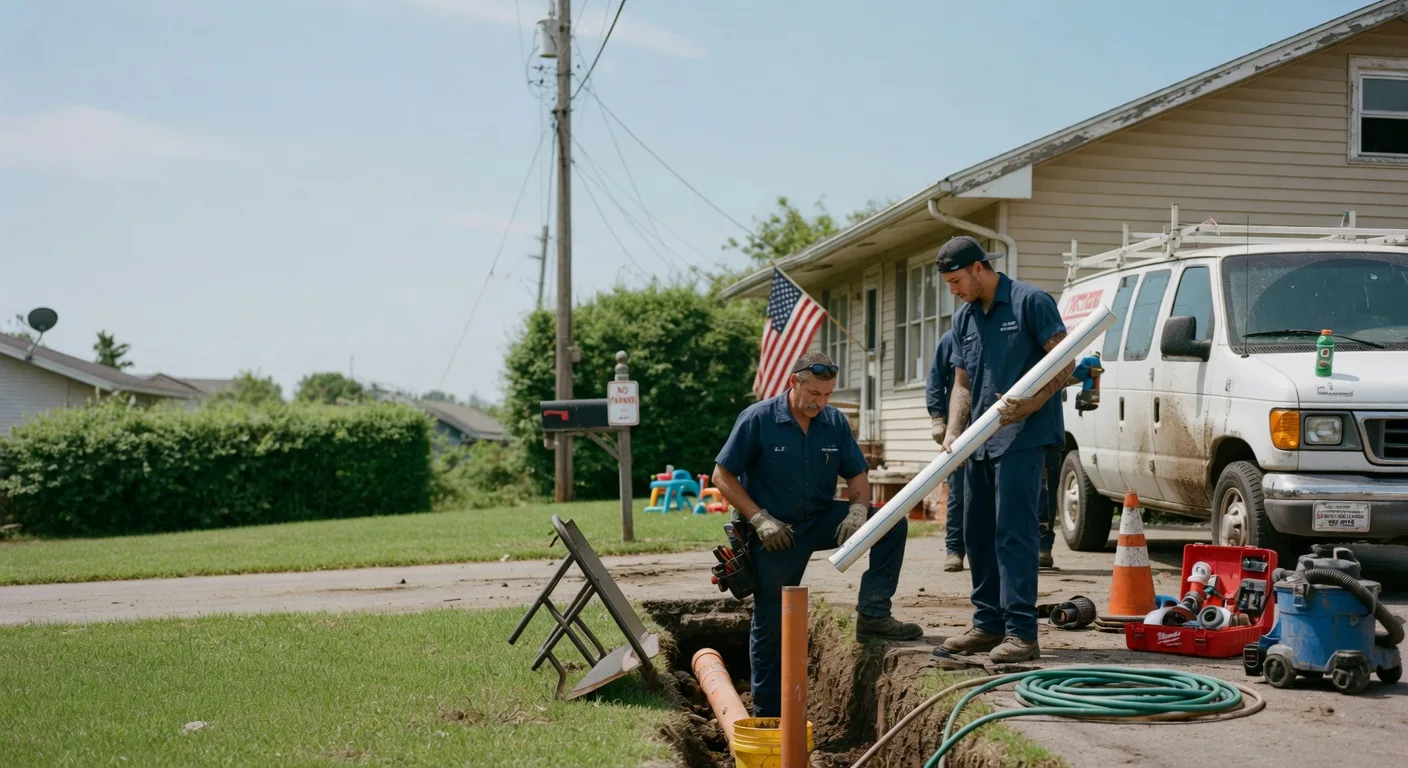
Safe homeowner check: walk the outside of the house. See where each downspout ends. Does it spill onto the ground, or vanish into a pipe in the soil? Does the sump pump discharge run out to daylight, away from the foundation, or into a pipe tied to the house drain? Look only. Do not dig.
Stop running water and call now if more than one fixture is backing up, if sewage is rising, or if it is reaching the floor. A single slow sink is a different job, and a cable machine usually handles it. A storm-driven backup is not a clog, so cabling will not cure it.
A plumber finds the connection with a camera inspection, which shows a tie-in on the pipe, or a dye test, where colored water poured into a downspout or sump shows up in the sewer. What the work involves depends on access, the materials, how much has to be opened up, and any permit requirement.
Expert Plumbers Co is a referral service. We refer homeowners in Julian, NE to an independent local plumber for Drain Cleaning and Emergency Drain Cleaning. Call (380) 262-9173.
Once the connection is found, the usual fix redirects the storm water instead of changing the sewer. Downspouts can be extended to discharge onto the ground well away from the foundation, with the soil graded to carry water off. A sump discharge should run outdoors to daylight or to a drainage point that local code accepts.
A common mistake is capping the old pipe at the wall and leaving the buried tie-in open to the sewer. An open stub can still admit soil, roots and water. Ask the plumber to confirm the old connection is sealed at the sewer end, not just hidden from view.
Sump pumps run hardest during the very storms that load the sewer, so a pump that cycles constantly is worth mentioning on the call. After the change, watch the next heavy rain. The floor drain should stay quiet. If it still gurgles, the cause may be the street main or a damaged lateral, not the tie-in.
Two houses share one sewer line. Whose blockage is it?
Your basement drain is backing up and the neighbor says theirs is fine. Or both are backing up and each blames the other. On a shared sewer lateral, that argument is common.
In older terraced or paired properties, two buildings join one lateral before it reaches the main. A blockage downstream of that junction backs up into whichever building sits lower. That is often not the building that caused it. Roots at a clay joint, grease build-up or a bellied line can sit past the junction and still flood one side.
One slow sink is local, and a cable machine usually clears it. Every drain in the building backing up points to the lateral. That calls for a camera inspection, and often hydro jetting.
A camera inspection and a locator establish where the junction is and where the blockage point sits. Distance readings matter: how far from the cleanout to the junction, and to the fault. They show which side of the junction the fault is on.
Responsibility depends on local rules and on where the fault sits. Some places treat the shared section as a joint matter for the owners, others place part of it with the utility. Do not assume. The city or sewer utility can say how it works for a given address.
Safe homeowner check: ask the neighbor if they have symptoms, and hold off on water use. Stop running water and call now if sewage is rising in a tub, shower or floor drain. What a repair involves depends on access, the materials, how much has to be opened up, and any permit or code requirement.
Expert Plumbers Co is a referral service. We refer homeowners in Julian, NE to an independent local plumber for Drain Cleaning and Emergency Drain Cleaning. Call (380) 262-9173.
Before anyone argues about cost, get the facts in hand. Agree with the neighbor to share the camera footage and the distance readings, so both households work from the same picture. Check the property records for any easement or shared-line agreement, since some older properties carry one. Ask the local building department or sewer utility who maintains the section between the junction and the main.
Ask your home insurer whether sewer backup is covered. Many policies treat it as an optional add-on, and a claim usually needs documents.
Once the line is clear, the sensible follow-up is a maintenance plan both sides accept. That might be periodic jetting, or a cleanout fitted at the junction so future blockages can be reached without digging. A cleanout in the right spot turns a future emergency into a short job. Keep the plumber's written findings. They settle most disputes about where the fault sat.
Can a drain under a concrete slab be cleared without breaking the floor?
Usually, yes. Clearing a blockage and repairing a broken pipe are two different jobs, and only the second one needs the floor opened.
In a slab-on-grade house the drain lines run inside or beneath the concrete. There is no crawlspace to inspect, so symptoms are the only evidence you have. A cable or a hydro jetter still reaches the line through a cleanout or through a pulled toilet. Grease build-up on the pipe wall, roots in a joint and scale in cast iron can all be cleared that way.
What does need the floor opened is a cracked, collapsed or bellied section under the slab. A bellied line holds water and collects waste however often it is cleared. In older housing stock where clay or cast iron was the standard, failed sections are more likely.
A camera inspection with a locator pinpoints the fault. The plumber finds the exact spot and marks it on the floor before anything is cut, which keeps the opening small. What the job involves is driven by access, the materials, how much concrete must be opened and removed, and any permit or code requirement. Opening a slab often brings one in.
Safe homeowner check: note whether one fixture is slow or every drain is affected. A single slow fixture is usually a cable job on a branch line. Every drain backing up points to the main line or the sewer lateral.
Stop running water and call now if the whole house is backing up. Report water staining or a warm, damp patch on the floor, because it can mean a leak under the slab.
Expert Plumbers Co is a referral service. We refer homeowners in Julian, NE to an independent local plumber. Call (380) 262-9173.
A spot repair under a slab is more disruption than most people picture. The plumber breaks out a section of concrete, digs down to the pipe, replaces the damaged length, and the floor is patched. Dust, noise and a few days without some fixtures are normal. Furniture and flooring over the area must be moved first, and tile or a finished floor may not match after patching.
For longer runs of damage, some plumbers can line the pipe from inside, or route a new line overhead or outside the house, which avoids cutting the slab. Whether either suits your pipe depends on its condition and on local code.
Ask to see the camera footage and the locator mark on the floor before any cutting begins. Mention in-floor heating, radiant tubing or a post-tension slab if you have one. Cutting into those without knowing is dangerous, so the plumber needs to hear about them before a saw comes out.
Since we put in a water softener, the floor drain or laundry drain backs up when it regenerates. Are they related?
The softener finishes its cycle and a minute later the laundry drain gurgles or the floor drain spits up gray water. You did not have this before, so it is fair to wonder if the softener caused it. In most cases it did not cause the clog. It exposed one.
During regeneration, a softener flushes brine and rinse water out through a drain hose, usually into a standpipe, laundry tub or floor drain. That water arrives in bursts, and the volume is sudden. If the drain line is clear, it carries the surge without trouble. If the line has a partial clog, such as grease build-up on the pipe wall, a root mat at a clay joint or a belly holding water, the burst is more than it can pass, and the water rises in the lowest drain.
The discharge also needs to be set up properly. Most plumbing codes require an air gap, a physical space between the end of the softener drain hose and the drain, so wastewater cannot siphon back into the softener. A hose pushed deep into a standpipe, or taped tight to it, can cause splashing and backflow of its own. Rules vary by area, so the installer or local building department can say what applies in Julian, NE.
The key question is how widespread it is. If only the standpipe backs up, the trouble may be the standpipe, its trap or the softener hose. If the floor drain, laundry drain and a basement toilet all react, the main drain is partly blocked, and the softener is just the first thing to push it over the edge.
Safe homeowner check: look at where the softener hose ends. Make sure it sits above the drain with a visible gap and is not kinked or pushed down inside the pipe.
Stop running water and call now if sewage is coming up through the floor drain, if water is spreading across the floor, or if you smell sewage.
A cable machine is often enough for a soft clog in a short branch. If roots, a belly or grease are suspected, the work calls for a camera inspection and hydro jetting.
Expert Plumbers Co is a referral service. We connect you with an independent local plumber in Julian, NE. Call (380) 262-9173.
Tell the plumber the problem started after the softener went in and when in the cycle it shows up. Ask them to check the air gap and the standpipe as well as the main. Scope depends on access to the line, parts for any standpipe or hose changes, how much has to be opened up if a section is damaged, and any code requirement.
We wash the dog or muddy gear in the tub or laundry sink. Can sand and mud clog the line?
Washing the dog in the tub feels harmless. The water runs away, the bathroom smells of wet fur, and an hour later the tub drains slowly. Muddy boots, gardening gear and sports kit in the laundry sink do the same thing over time. Yes, sand and mud can clog a line.
The problem is how they travel. Water carries sand and grit along, but only while it is moving fast. In a trap, a flat run or a low spot in the pipe, the flow slows and the grit drops out. It settles, packs down and mixes with pet hair, soap and grease to form a dense sludge. Each wash adds a little more. Eventually the pipe is narrow enough that normal use overflows it at peak load.
Hair and grit also catch on any rough spot, such as scale in cast iron or a root mat at a clay joint, and a bellied line holds the settled material in place. It does not flush away on its own.
The key question is where it is happening. If only the tub or laundry sink drains slowly, the clog is likely in that fixture's trap or branch line. If the toilets gurgle and other drains back up as well, the sludge has moved into the main.
Safe homeowner check: stop washing pets or gear in the tub and laundry sink for now. Fit a fine hair catcher over the drain. Use a bucket and the yard hose for muddy boots and dog baths outside when weather allows. Do not pour chemical drain cleaners into a line with packed sand, since they do not dissolve it.
Stop running water and call now if sewage or gray water is coming up in a tub or floor drain, if the drain is overflowing, or if you smell sewage. Do not keep running the washer while the line is backed up.
A cable machine can open a path through packed sludge, but it often leaves settled sand behind, so the drain slows again. Hydro jetting flushes the sand and mud out of the line. If the trouble keeps returning, a camera inspection shows whether a belly, root intrusion or damaged joint is trapping it.
Expert Plumbers Co is a referral service. We connect you with an independent local plumber in Julian, NE. Call (380) 262-9173.
Tell the plumber exactly what goes down the drain, including pet washing. Ask whether the trap was cleaned and whether the main was jetted or only cabled. Scope depends on access, how far the buildup extends, whether a section has to be opened up, and any permit or code requirement for repairs. A cleanout near the fixtures makes future service simpler.